
Call us now :08071931774
 Send Inquiry
 Send Inquiry
Pit Car Parking System
Price 200000.0 INR/ Unit
MOQ : 1 Unit
Pit Car Parking System Specification
- Product Type
- Pit Car Parking System
- Width
- 2700 mm
- Height
- 2050 mm
- Single Vehicle Weight
- 2000 kg
- Container Load
- 6 Sets / 40HQ
- Operation Way
- Hydraulic, Fully Automatic
- Power of Motor
- 2.2 kW
- Mode Of Drive
- Chain Drive
- Safety Mechanism
- Mechanical Lock
- Lifting Capacity Per Platform
- 2300 kg
- Installation Method
- Pit Installation
- Platform Surface Treatment
- Galvanized Coating
- Application
- Residential and Commercial Parking Lots
- Ambient Temperature
- -10C to +40C
- Parking Capacity
- 2 Cars Per Unit
- Noise Level
- Less than 60 dB
- Power Supply
- AC 220V/380V, 50Hz
- Rising Speed
- 8 m/min
- Control System
- PLC Controlled
- Material
- High Strength Steel
Pit Car Parking System Trade Information
- Minimum Order Quantity
- 1 Unit
- Payment Terms
- Cheque
- Supply Ability
- Unit
- Delivery Time
- 60 Days
- Main Domestic Market
- Maharashtra
About Pit Car Parking System
Pit Car Parking System
As one of India's leading manufacturers and suppliers, we are offering a qualitative range of Pit Car Parking System. Offered range has three segments top, middle and bottom, which are united and lifted together; the middle and bottom pits are located underground in the pit. Entire range of Pit Car Parking System is manufactured by using super grade of raw materials procured from reliable vendors of market using latest technology.
Features:
- Save space
- High load bearing capacity
- Trouble free parking
| Specifications: | ||||
size (mm) | L | 5200 | 5000 | 4700 |
| W | 1900 | 1850 | 1800 | |
| H | 1550 | 1550 | 1450 | |
| Weight (kgs) | 2000 | 1800 | 1500 | |
| Suitable vehicle model | T (over-large) model | D (large) model | Z (medium) model | |
| Capacity of vehicles | 6 n-5 (n=levels) | |||
| Lifting motor power | 2-3level 2.2kw / 4-6level 3.7kw | |||
| Sliding motor power | 0.2kw | |||
| Lifting speed | 4-6m/min | |||
| Sliding speed | 7-8m/min | |||
| Max. Noise | 60dB(A) | |||
| Max. Collection time | 82s | |||
| Lifting driven mode | Steel rope | |||
| Control mode | PLC | |||
| Operate mode | Buttons, touch screen, ID Cards (option) | |||
| Power | AC 3phase 380V/220V 50HA/60HZ | |||
Efficient Space Utilization for Urban Parking Needs
Maximize your parking potential with the Pit Car Parking System, crafted to meet the spatial constraints of modern urban residences and commercial complexes. With the ability to accommodate two vehicles per platform in a vertical configuration, this system effectively doubles available parking without expanding your footprint. High-strength materials and precision engineering ensure long-lasting functionality, making this solution ideal for property developers and facility managers.
Advanced Safety Features and Easy Operation
Safety and usability are at the forefront, with the system integrating a mechanical lock mechanism and PLC-controlled automation. The hydraulic, chain-driven operation guarantees stable lifting and lowering, while the galvanized surface treatment protects the platform from corrosion. It is engineered for noise control, running at less than 60 dB, ensuring a quiet and safe user experience throughout its operational lifespan.
FAQs of Pit Car Parking System:
Q: How does the Pit Car Parking System function?
A: The system operates using a fully automatic, PLC-controlled hydraulic mechanism and chain drive. Vehicles are parked on galvanized platforms that are lifted or lowered into a pit, optimizing parking space by allowing two cars per unit to be stacked safely and efficiently.Q: What is the installation process for this parking system?
A: The system is designed for pit installation, requiring groundwork to create a suitable pit that matches the systems height and width. Professionally trained technicians from the manufacturer or service provider install the equipment and set up the control mechanisms, ensuring secure and precise operation.Q: Where can the Pit Car Parking System be used?
A: It is suitable for both residential and commercial applications, particularly in locations where ground space is limited. The system is widely utilized in apartment complexes, office buildings, malls, and hotels across urban environments.Q: When should property owners consider installing this parking solution?
A: Property owners should consider this system during new construction or renovation projects, especially when parking demand exceeds available space. It is also beneficial for upgrading existing parking areas to increase vehicle capacity without significant structural expansion.Q: What safety mechanisms are integrated into the system?
A: A robust mechanical lock is built in to ensure platforms stay securely in place while vehicles are parked or during maintenance. The PLC controls also add layers of operational safety, reducing risks associated with manual handling.Q: How does the material and surface treatment benefit users?
A: The use of high-strength steel and a galvanized coating enhances durability, providing resistance to corrosion, reducing maintenance needs, and ensuring the system retains its load-bearing capacity over years of service.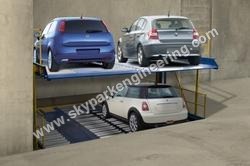
Tell us about your requirement

Price:
Quantity
Select Unit
- 50
- 100
- 200
- 250
- 500
- 1000+
Additional detail
Mobile number
Email


 Send Inquiry
Our Products
- Single Pole Car Parking System
- Car Parking System
- Two Step Car Parking System
- Three Step Parking System
- Multi Car Parking System
- Puzzle Car Parking System
- Tower Parking System
- Elevator Parking System
- Rotary Parking System
- Rotary Table
- Stack Car Parking System
- Vertical Building Parking System
- Hydraulic Car Parking System
- Pit Car Parking System
- Lapping Machine
- material handling equipment
- Parking spare parts
- HYDRAULIC SERVICES


401, Marigold Bldg, Runwal Garden City, Balkum, Thane - 400607, Maharashtra, India

Mr. H. M. Pedhavi
Mobile :08071931774
Mr Swapnil Pedhavi
(Proprietor)
Mobile :08071931774
 Send Inquiry
 Send SMS
Developed and Managed by Infocom Network Private Limited.


 English
 Spanish
 French
 German
 Italian
 Chinese (Simplified)
 Japanese
 Korean
 Arabic
 Portuguese